On May 16, 2026, the Arlington County Board approved JBG Smith’s application to convert two aging Crystal City office buildings—1800 and 1901 S. Bell Street—into 315 residential units, marking a significant implementation of the County’s recently adopted Adaptive Reuse Policy.
The two buildings, historically known as Crystal Mall I and Crystal Mall IV, were originally constructed in the late 1960s as part of the larger Crystal Mall development. In the ensuing decades, the buildings have become increasingly difficult to market for contemporary office use due to outmoded floorplates, constrained ceiling heights, lack of dedicated tenant outdoor space, and other limitations.
As approved, 1800 S. Bell Street will contain 129 residential units and approximately 5,250 square feet of ground-floor retail space, while 1901 S. Bell Street will contain 186 units and approximately 4,700 square feet of retail space. Notably, approximately half of the new residential units will contain two or three bedrooms, providing larger units than are typically found in new multifamily construction.
Exterior improvements will include new windows and glazing, façade enhancements, new residential entrances, landscaping- improvements designed to better activate the buildings and surrounding public realm.
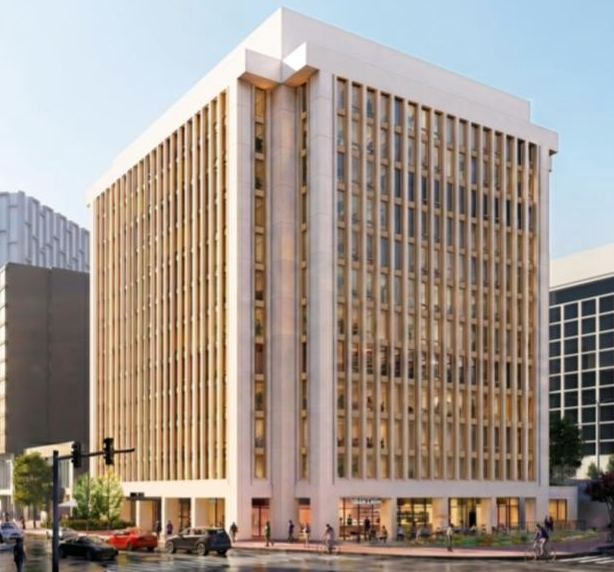
Rendering of 1800 S. Bell; ZGF Architects
The project represents the latest step in JBG Smith’s more than decade-long revitalization of National Landing. In recent years, the neighborhood has seen the addition of more than 1,600 new apartments, a tripling of the amount of retailers, and significant improvements to the public realm and open spaces, including the Water Park along Crystal Drive.
The conversion of 1800 and 1901 S. Bell Street builds upon that momentum while illustrating the potential of Arlington’s Adaptive Reuse Policy to address two challenges simultaneously: removing obsolete office inventory while adding housing in transit-rich locations.
Rather than demolishing buildings that no longer meet modern office demands, the project will extend the useful lives of both structures, introduce new residents and economic activity within National Landing, and return underperforming properties to productive use. Preservation and reuse of the existing buildings is also projected to substantially reduce the project’s carbon footprint compared with demolition and new construction.
Of equal significance, the conversions will remove approximately 490,000 square feet of obsolete office space from National Landing’s inventory and are expected to reduce Crystal City’s office vacancy rate by approximately 3.5 percentage points.
The approval provides an important early example of Arlington’s new adaptive reuse framework in action—and demonstrates how the County and property owners can reposition aging commercial buildings in response to structural changes in the office market while simultaneously advancing housing, economic development, and sustainability goals.
The Walsh Colucci team included land use planner Elliott Young and partner Andrew Painter, who represented the application before the County Board.